
Health & Sleep · 7 min read
Why I Tell My EDS Patients to Stop Buying Pillows
A doctor who spent years treating hypermobility patients explains why the fix for their sleep was never going to come from a pillow aisle, and what he built instead.

The short version
- Hypermobile joints lose muscular guarding during sleep. Support has to come from outside the body
- Ordinary pillows can create a good position, but nothing holds it past the first roll
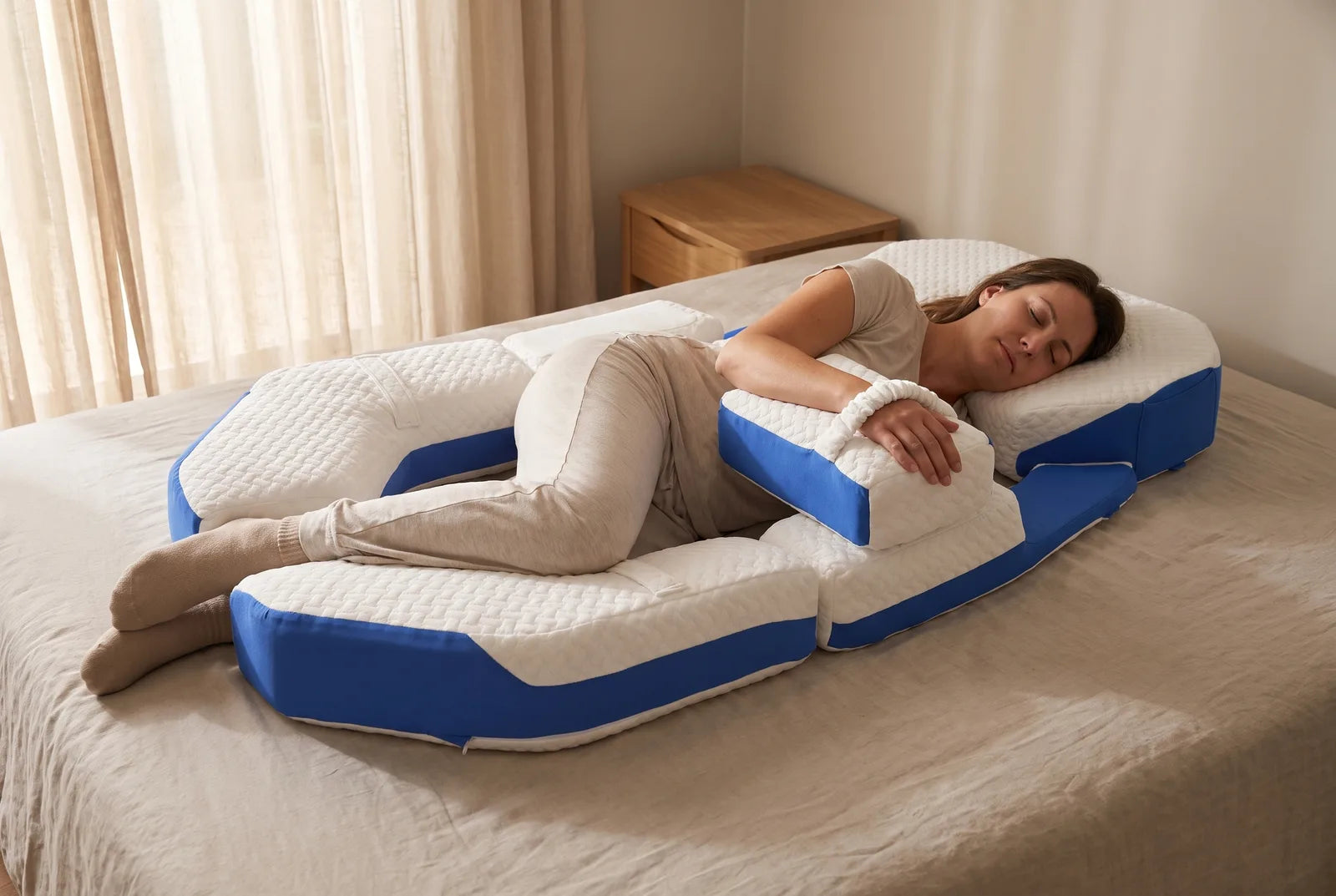
- Dr. Fu's fix was structural: one connected system, head to ankles, strapped so it can't drift
- 120 nights to test it at home, HSA/FSA eligible
If you have EDS or hypermobility, I already know what your bed looks like.
Three pillows, maybe five. One between the knees. One wedged behind your back. One you hug to keep your shoulder from collapsing forward. A careful architecture you rebuild every single night, and every night, sometime around 2 a.m., it falls apart.
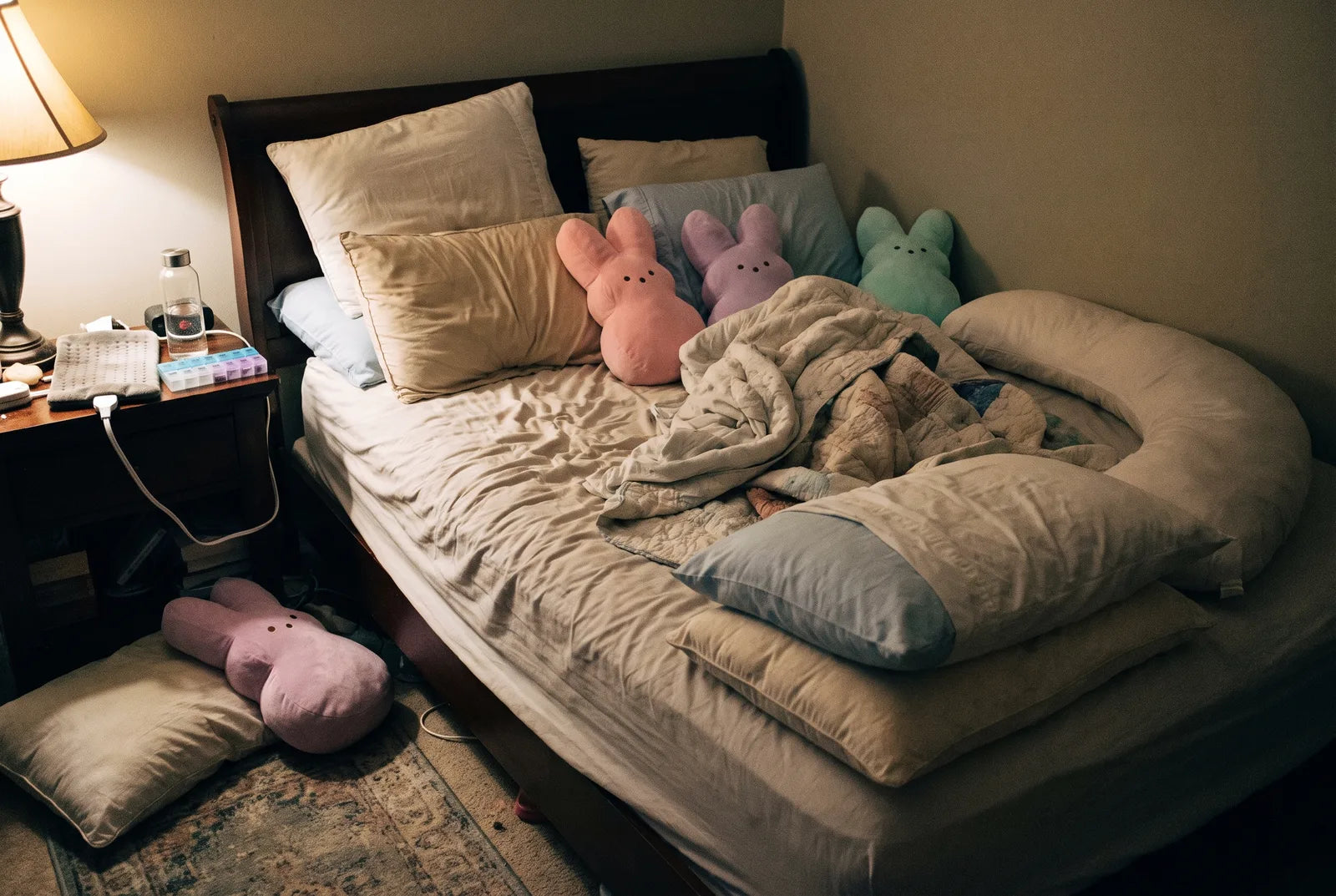
You shift. The pillows scatter. And you wake up with a subluxed shoulder, a screaming hip, or that deep, familiar ache that means today is going to be a bad day.
Every day in my practice, I see patients living exactly this. For years, I gave them the same advice every doctor gives: try a body pillow, try a wedge, try memory foam.
I was wrong to. Here's why.
The problem was never the pillow. It's that pillows don't hold.
A hypermobile body doesn't just need cushioning at night. It needs positioning.
Awake, your muscles quietly guard every loose joint without you noticing. Asleep, that guarding switches off. With lax connective tissue, there is nothing left holding the line, so gravity does whatever it wants with you. That is why shoulders drift, ribs twist and hips rotate specifically at night.
The research on side-sleeping alignment points to a specific posture: spine neutral, body supported at roughly a 45° angle, joints stacked instead of hanging.³ An ordinary pillow can put you in that position. Nothing about it can keep you there for eight unconscious hours.
That is the whole failure, and no amount of memory foam fixes it.
One night in clinic changed how I thought about this
A patient, a woman in her thirties with hEDS, described her nightly routine to me in detail: seven pillows, arranged in the same order, every night, "like scaffolding." Her word.
She wasn't sleeping on a pillow. She was trying to build a structure out of parts that were never designed to connect.
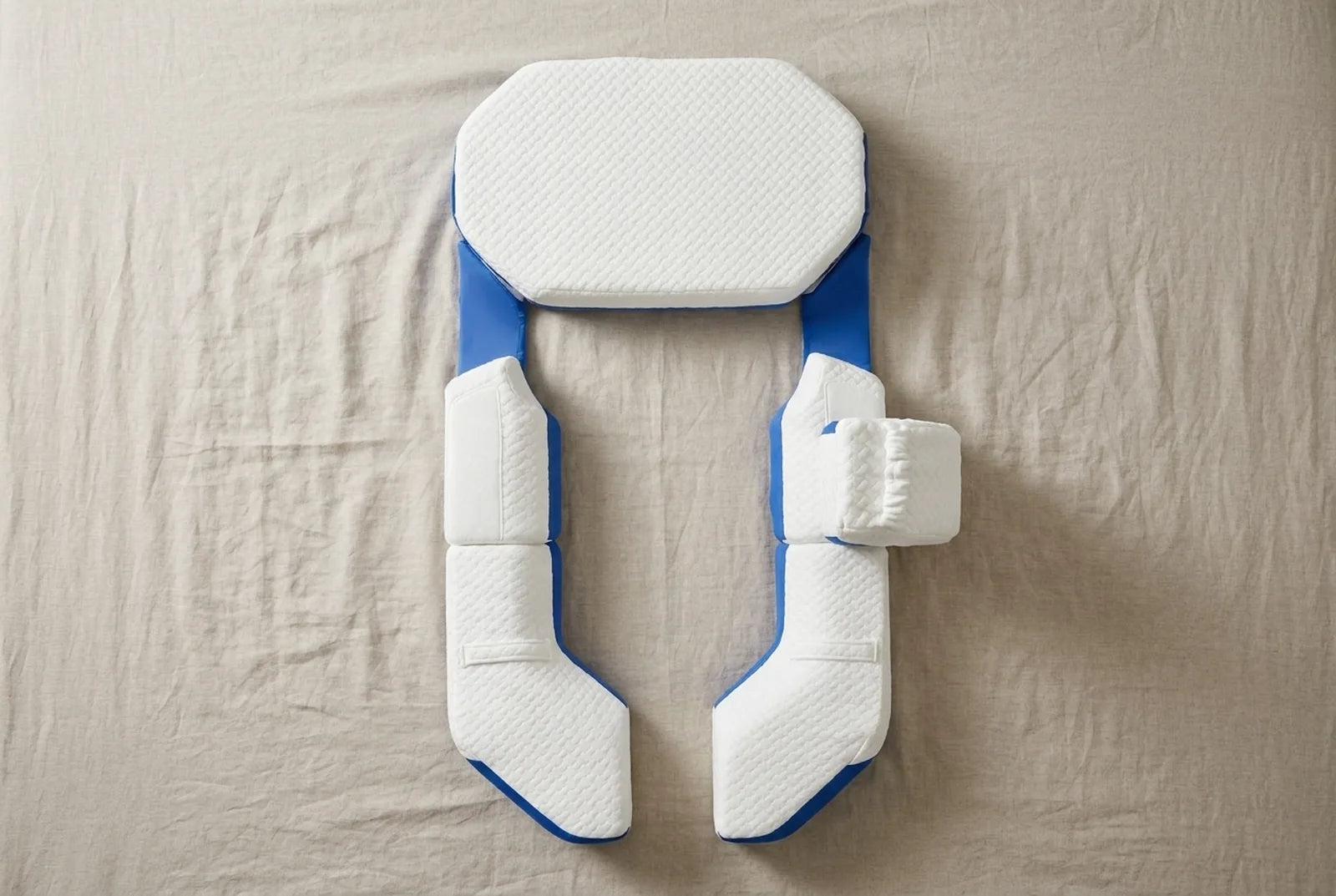
That was the insight. My patients didn't need a better pillow. They needed the structure itself: one engineered piece, from head to ankles, that cannot drift apart at 2 a.m.
So I built it
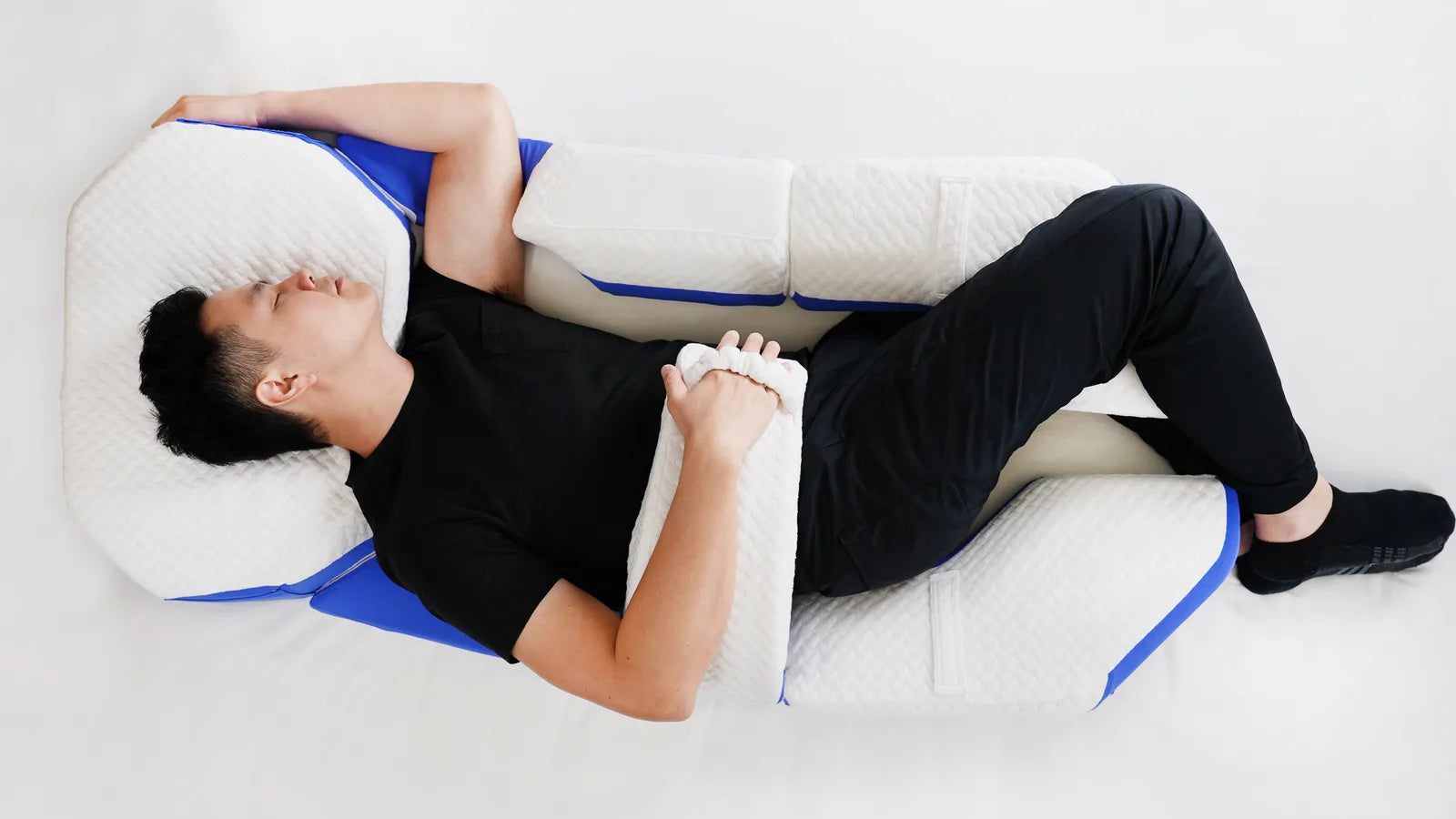
See how the system is built
The full breakdown: every module, how it sizes to your bed, and how it reconfigures for side, back and post-surgical sleeping.
See how it worksSkip ahead to pricing and the 120-night trial →4.8 · 832 reviews
Why the usual fixes fall short
| Pillow fort | Body pillow | Modular Pillow | |
|---|---|---|---|
| Holds position all night | No, scatters | Partly, slides | Yes, strapped as one piece |
| Supports head to ankles | Improvised | Torso only | Yes, full chain |
| Adapts to your condition | Trial and error | Fixed shape | Modules reconfigure |
| Rebuild required nightly | Every night | Often | No |
| Designed for hypermobility | No | No | Yes, built in clinic |
What my patients report
Since putting it into patients' hands, the pattern is consistent: fewer nighttime subluxations, less morning pain, joints that stay where they were put, and the one they mention most, mornings that no longer start with an inventory of what went wrong overnight.
“Worth it”
I was so skeptical at first. It took me a few minutes to get used to the feel of it. Then I just slept the deepest I ever have. For someone with HEDS who dislocates and subluxes joints in sleep frequently then wakes up all night with pins and needles from nerves not getting enough oxygen, it was amazing not to wake up in the night in pain constantly. It supports every sleep position, you just wedge yourself in this perfect nest and your shoulders are held in place. I woke up feeling so good I cleaned my entire house then did a 2 hour ballet class with no pain.
“Top surgery recovery & EDS lifesaver”
I have EDS and I bought this before my top surgery because I was nervous about accidentally rolling onto my chest while sleeping. The first few nights after surgery this thing was honestly a lifesaver. The side supports kept me from turning over and the knee pillows made back sleeping way more comfortable than I expected. I was waking up a lot the first week but I could actually fall back asleep without having to rearrange a million pillows.

“But I've tried everything.”
I hear this in my practice every day, and I take it seriously. EDS patients have usually spent more money on failed sleep products than anyone I treat. Most have a closet of them.
That is exactly why the Modular Pillow ships with a 120-night trial. Not 30 days, which tells you nothing when your symptoms fluctuate week to week. Four months, at home, in your own bed. If your nights aren't better, send it back.
The Modular Pillow®
Complete sleep positioning system, head to ankles. Five components, one connected structure.


Sleep on it for four months. Send it back if your body doesn't agree. · HSA/FSA eligible
Questions I get asked most
I subluxate in my sleep. Will this actually stop that, or just cushion me?
It is a positioning system, not a cushion, and that distinction is the whole point. The rails hold your torso at a supported side-lying angle so the shoulder underneath isn't carrying your body weight and the top hip isn't rotating forward. Patients with hEDS most often tell me the change is fewer joints going somewhere they shouldn't overnight. It cannot make your connective tissue behave (nothing can), so you get 120 nights to see what it actually does for your body.
My hands are affected. Can I set it up and re-fasten it myself on a bad day?
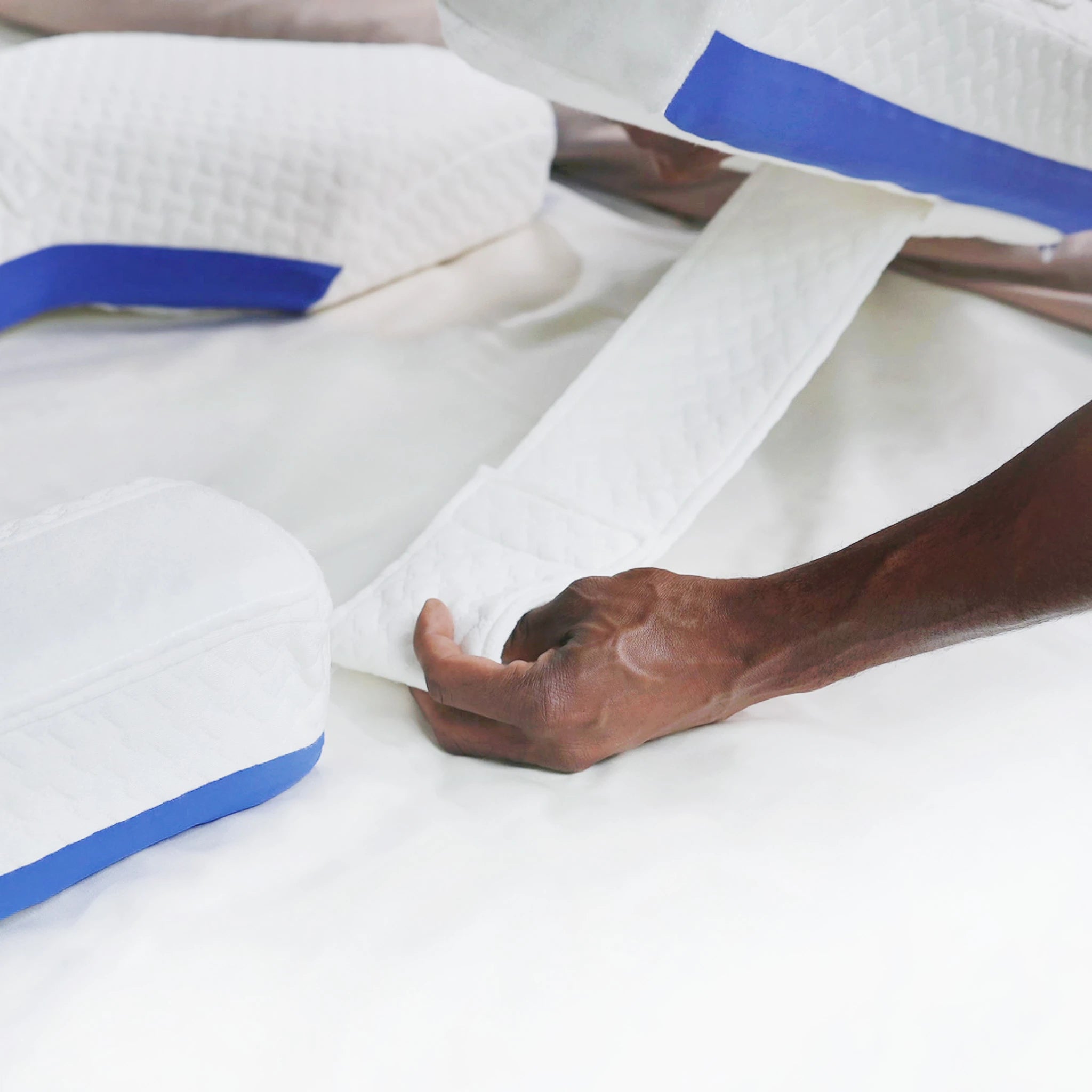
A fair question, and one I get from hypermobile patients specifically. The modules attach along the rails and the case set now uses snap closures rather than the older hook-and-loop, which several customers found degraded with repeated washing. If grip strength or finger subluxations make fastenings genuinely difficult for you, say so before you order and we will walk you through the setup that needs the fewest adjustments.
I have MCAS and reactive skin. What is it actually made of?
The covers are a soft, breathable cotton fabric, closer to a high-end bedsheet than to technical fabric, over a supportive foam core. The covers are removable and machine washable, and you can put your own case over the top if you react to unfamiliar textiles. If you have a specific confirmed allergy, email us before ordering and we will tell you exactly what is in it rather than guess here.
I'm having surgery. Can I use it during recovery?
Yes, and a number of patients buy it specifically ahead of a procedure. The side supports make rolling onto a healing site take real effort, which matters most in the first weeks when you're waking often. It reconfigures for back sleeping too, so it stays useful as your recovery position changes.
It costs a lot more than a pillow, and I've already wasted money on pillows.
I know, and EDS patients have usually wasted more than most. Add up what the closet of failed pillows, wedges and body pillows actually cost you. What I would say is that this replaces the four or five separate pillows you keep buying and rebuying, and that the 120-night trial exists precisely because I cannot promise you in advance which bodies it helps. If it isn't one of them, you send it back. It is also HSA/FSA eligible, which for many of my patients changes the real number.
Stop rebuilding the fort every night
One connected system that holds its position from lights-out to morning. You have 120 nights to find out whether your body agrees.
Start my 120 nightsStill not sure if it's right for you? Take the 2-minute quiz →4.8 · 832 reviews · 120-night trial · HSA/FSA eligible
References
- Survey of hypermobile adults on nightly sleep-support habits.
- Comparative reporting of waking pain in hypermobility spectrum disorders vs. general population.
- Literature on supported side-lying angle and joint loading during sleep.
This is a paid advertisement for the Modular Pillow by Doctor Trigger.
The Modular Pillow is a sleep positioning system, not a medical device, and is not intended to diagnose, treat, cure or prevent any disease. It is a complement to, not a replacement for, care prescribed by your own clinician. Individual experiences vary; the reviews shown are individual results and are not a guarantee of what any particular customer will experience. 120-night risk-free trial on every order.