
Health & Sleep · 7 min read
Same Shoulder Pain, Every Morning: Why I Tell Side Sleepers to Stop Buying Pillows
Your shoulder shouldn't be your mattress. A doctor explains why the joint that wakes you up was never going to be fixed from the pillow aisle, and what he built instead.

The short version
- Your downside shoulder carries your whole upper body for six to eight hours a night. That is the load, and no pillow changes it
- Loft positions your head. Your head was never the part under pressure
- Your top arm falls across your chest and pulls the shoulder underneath forward all night, which is why it aches worst on waking
- Dr. Fu's fix was a supported tilt that unweights the joint, plus a cradle that gives the top arm its own place to rest
- 120 nights to test it at home, HSA/FSA eligible
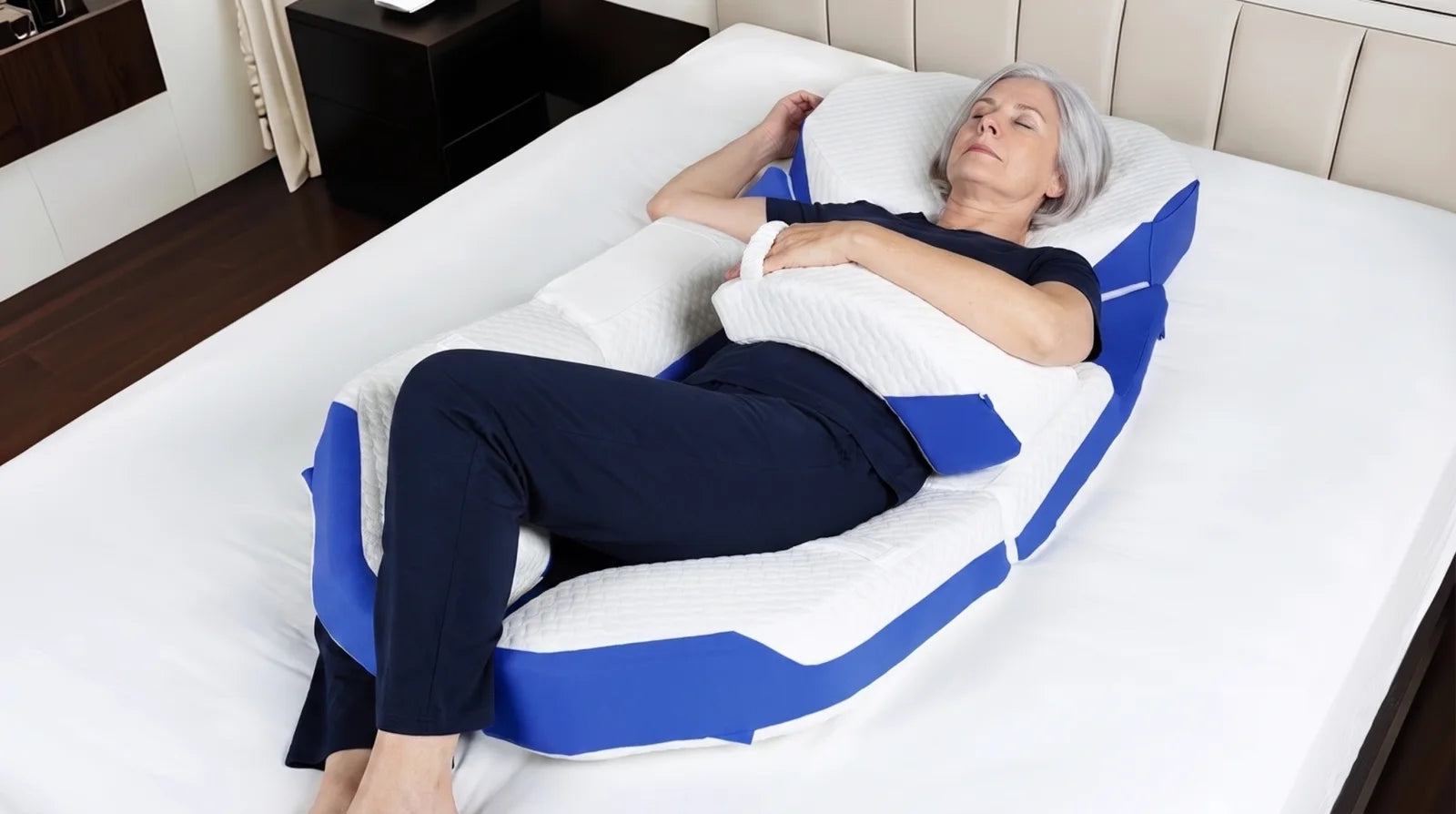
If the same shoulder hurts every morning, I can probably describe your closet.
A contour pillow. A cervical roll. The one with the ear cutout. A wedge you bought after a bad week. Somewhere near the back, the memory foam one that was definitely going to fix it. Four, maybe five purchases, each one a genuine attempt, and the same shoulder aching at 6 a.m. anyway.

You are not shopping badly. Every one of those pillows solved a real problem. It just wasn't your problem.
Every day in my practice I see the same person: a lifelong side sleeper with shoulder pain, a numb arm, tingling fingers, and a quiet worry that they are doing permanent damage to a rotator cuff. For years I gave them the advice every clinician gives. Try more loft. Try a softer pillow. Try memory foam.
I was wrong to. Here's why.
The pillow was never the thing under pressure. Your shoulder was.
Here is the mechanics of it, and once you see it you cannot unsee it.
When you lie on your side, your head needs a few inches of support to keep your neck in line with your spine. That is what a pillow does, and a good one does it well. But your head is not the part that hurts.
Underneath it, your entire upper body, shoulder girdle and ribcage and everything above your waist, is driving its weight down through a single joint. The same rotator cuff your doctor would tell you to protect. It holds that load for six, seven, eight hours. Then it does it again the next night, and the night after that.
Meanwhile your top arm has nowhere to go. It falls across your chest and stays there, rotating your torso forward and dragging on the shoulder underneath for the whole night.
Loft moves your head. It does not move the load.
The patient who made me stop recommending pillows
A man in his fifties came in for a shoulder that had been waking him for two years. Imaging was unremarkable. His exam was unremarkable. He was, by every measure I had, fine.
He was also, by his own count, four pillows deep. He listed them for me without being asked: memory foam contour, cervical roll, the cube-shaped one, a wedge. He had added up what they cost him. He knew the number.
Every one of those pillows had solved a problem. Not one of them had taken a single pound off the joint that was waking him up.
That was the thing I had been missing for years. He did not need a fifth pillow. He needed his body weight to stop landing on that shoulder, and he needed his top arm to have somewhere else to be.
Nothing on the market did either one.
So I built it
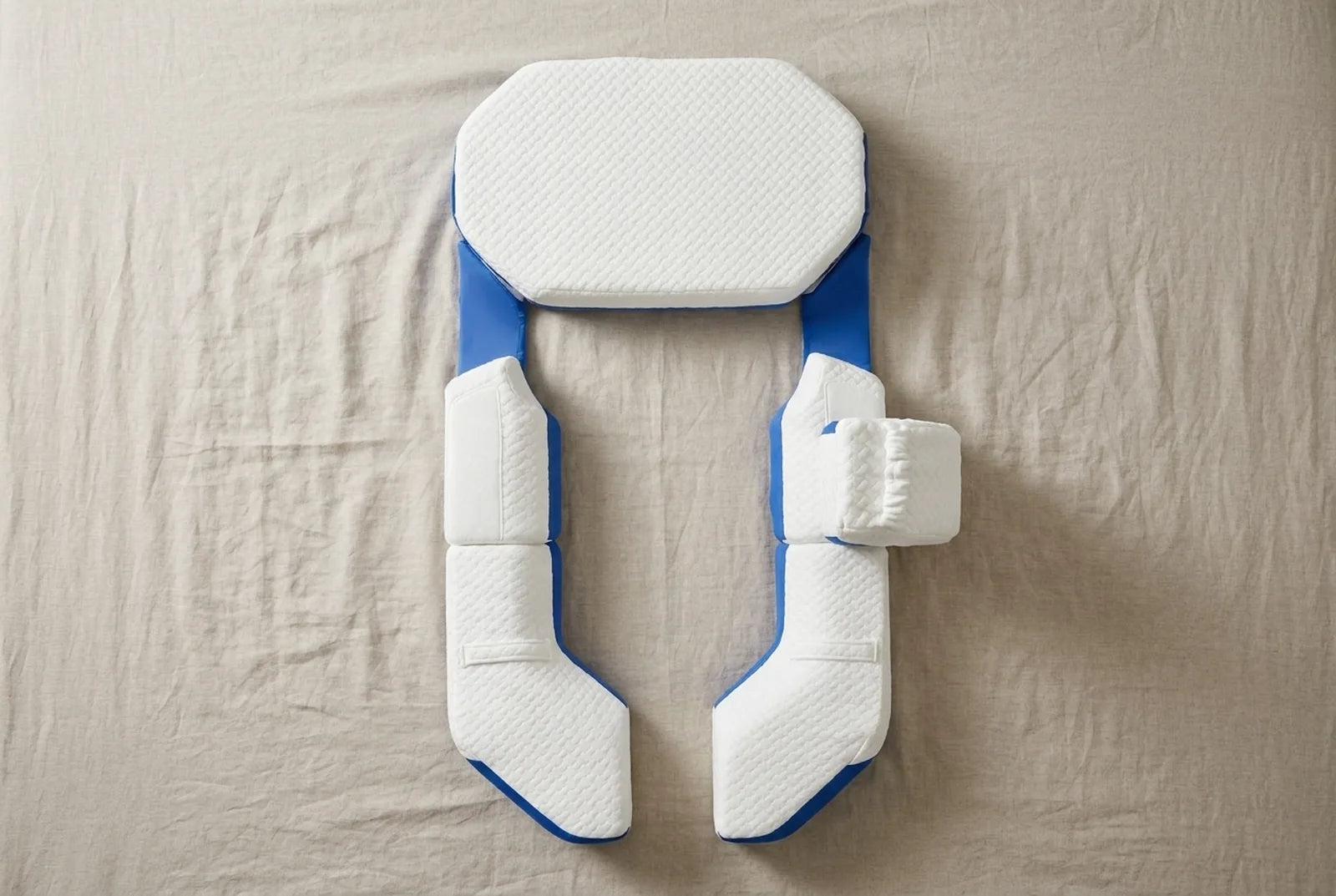
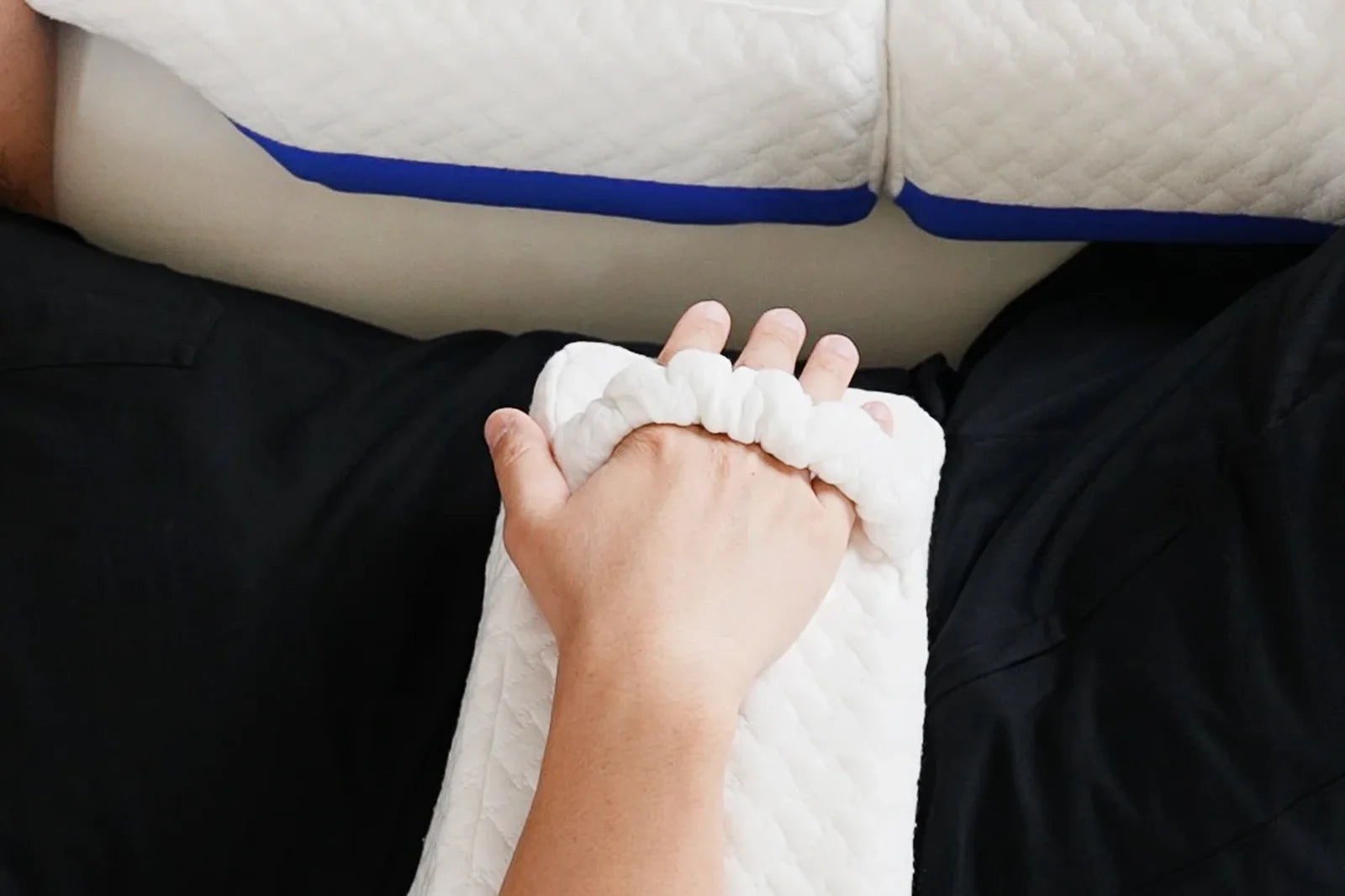
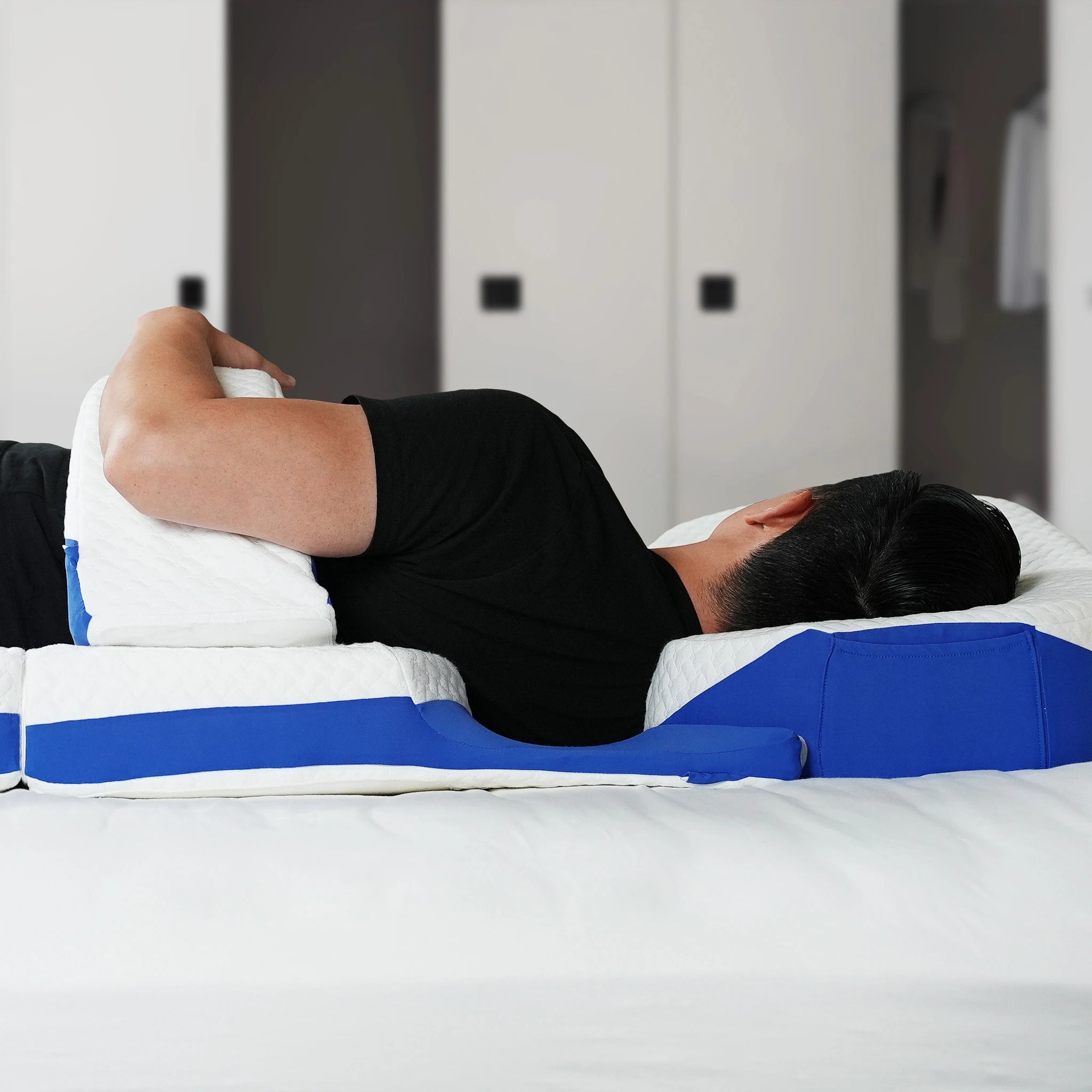
See how the load actually comes off
The full breakdown: every module, how the tilt is set, how the arm cradle attaches, and how it sizes to your bed.
See how it worksSkip ahead to the 120-night trial →4.8 · 832 reviews
Why the pillow upgrades keep failing
| Cervical / cutout pillow | Body pillow or wedge | Modular Pillow | |
|---|---|---|---|
| Unweights the downside shoulder | No, head angle only | Partly, then slides | Yes, supported tilt |
| Holds your top arm | Not addressed | Squirts out when you move | Quilted cradle on the rail |
| Controls hip rotation | Not addressed | No | Hips stacked, knees separated |
| Still in place at 3 a.m. | Head only | Often on the floor | Strapped as one piece |
| Rebuild required nightly | No | Every night | No |
What my patients report
Since putting it into patients' hands the pattern has been consistent, and it is not the one I expected. They rarely lead with pain scores. They lead with the wake-ups.
Fewer nights that end at 3 a.m. shaking out a dead arm. Fewer 4 a.m. decisions about which side to sacrifice next. And mornings that no longer start by testing the shoulder to see what kind of day it is going to be.
“No more dead arm”
It's the same for me for the past 15 years. A dead arm almost every night. It's definitely not good for my arm. But I've been trying different solutions including doing a similar set up as the modular pillow but with regular pillows. After using this, it's worth the hype and significantly better than my pillow fort.
“Post labrum surgery”
I tried a recliner, wedges, even stacking pillows but nothing worked. with this i can lay on my side a bit and my shoulder doesn’t scream at me. not perfect, but so much better than before.

“But I've tried everything.”
I hear this every day and I take it seriously. By the time a side sleeper with shoulder pain reaches me, they have usually spent more on failed pillows than this system costs, and they can tell you the running total.
That is exactly why the Modular Pillow ships with a 120-night trial. Not a two-week return window, which tells you nothing about a joint that took two years to get this way and has good weeks and bad ones. Four months, at home, in your own bed. If your shoulder disagrees, send it back.
The Modular Pillow®
Complete sleep positioning system, head to ankles. Five components, one connected structure.


Sleep on it for four months. Send it back if your shoulder doesn't agree. · HSA/FSA eligible
Questions I get asked most
I wake up with a dead arm and pins and needles. Is that what this is for?
It is one of the two things this was designed around. A numb arm on waking is usually a circulation and nerve-compression problem: your own body weight is sitting on the structures that run through your shoulder and down your arm, and your top arm is loading the joint from the other direction at the same time. The supported tilt takes the weight off the downside shoulder and the cradle holds the top arm off your chest, which addresses both directions at once. It is not a nerve treatment, and if the numbness is constant rather than positional, see your own clinician. If it is worst on waking and eases as you move around, that is the pattern this was built for.
I have a diagnosed rotator cuff tear. Will this help, or make it worse?
Take this one to your surgeon or physio first, and I mean that. What I can tell you is what the system does mechanically: it holds you in a supported side-lying position so the shoulder underneath is not bearing your upper-body weight, and it stops the top arm falling across your chest. A number of my patients use it while waiting on surgery and afterwards during recovery, when rolling onto the joint is the thing they are most afraid of. It cannot repair a tear. Nothing you sleep on can.
I flip sides all night. Won't I just roll off it?
Most side sleepers with shoulder pain flip precisely because the shoulder gives out, so the flipping usually reduces on its own once the joint is unweighted. Mechanically, the system is symmetrical: rails on both sides, so turning over lands you in a supported position rather than out of one. And because everything is strapped together it moves with you instead of scattering, which is the failure mode of every pillow stack. Aggressive movers do fine with it. Customers who describe themselves as tossers are some of the most positive.
Honest question, how is this different from an expensive body pillow?
A body pillow gives you bulk to hug. It does not set an angle, it does not hold one, and it does nothing for your hips. This sets a specific supported tilt, holds it with a center strap so it is still there at 4 a.m., supports the chain from head to ankles so hip rotation stops pulling through the shoulder, and includes an arm cradle, which as far as I know nobody else makes. If a body pillow had solved this, I would have told my patients to buy one. I did tell them to buy one, for years.
It costs a lot more than a pillow, and I've already wasted money on pillows.
Add up the closet. Most side sleepers who come to me have spent more on the failed attempts than this costs, in smaller amounts that were easier to justify. What I would say is that this replaces the stack rather than joining it, and that the 120-night trial exists precisely because I cannot promise you in advance which shoulders it helps. If yours isn't one of them, send it back. It is also HSA/FSA eligible, which for a lot of my patients changes the real number.
Will it take over the bed and annoy my partner?
It takes up roughly the width of two regular pillows and stays on your side. It is designed to fit two people on a queen or larger. In the morning the pieces stack together, or you can pull the covers over the whole thing and leave it. This is the most common thing people are surprised about, in both directions: it is smaller than they expected on the bed, and more visible than they expected when the bed is made.
Your shoulder has carried enough.
One connected system that takes your body weight off the joint and holds it there from lights-out to morning. You have 120 nights to find out whether your shoulder agrees.
Start my 120 nightsStill not sure it's your shoulder's problem? Take the 2-minute quiz →4.8 · 832 reviews · 120-night trial · HSA/FSA eligible
References
- Based on internal clinical testing and user feedback.
This is a paid advertisement for the Modular Pillow by Doctor Trigger.
The Modular Pillow is a sleep positioning system, not a medical device, and is not intended to diagnose, treat, cure or prevent any disease. It is a complement to, not a replacement for, care prescribed by your own clinician. Individual experiences vary; the reviews shown are individual results and are not a guarantee of what any particular customer will experience. Outcome figures are based on internal clinical testing and user feedback. 120-night risk-free trial on every order.